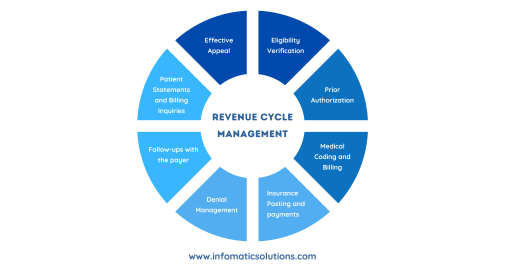

Revenue Cycle Management (RCM) is the financial backbone of healthcare organizations, covering everything from patient registration and insurance verification to billing and final payment collection. As the healthcare landscape evolves, the future of RCM is being reshaped by three powerful forces: automation, analytics, and patient experience. Together, these elements are transforming how providers manage revenue, improve efficiency, and deliver better outcomes.
Automation: Driving Efficiency and Accuracy
Automation is rapidly becoming the foundation of modern RCM. Tasks that once required extensive manual effort—such as eligibility verification, claim submission, coding, and payment posting—are now being streamlined through advanced technologies like Robotic Process Automation (RPA) and artificial intelligence (AI).
By reducing human intervention, automation minimizes errors, speeds up workflows, and ensures greater compliance with ever-changing regulations. For example, automated claim scrubbing tools can detect and correct errors before submission, significantly reducing claim denials. AI-driven systems can also predict potential issues based on historical data, allowing providers to take proactive measures. The result is faster reimbursements, improved cash flow, and more time for healthcare staff to focus on patient care rather than administrative tasks.
Analytics: Turning Data into Actionable Insights
In today’s data-driven world, analytics plays a crucial role in optimizing RCM performance. Healthcare organizations generate vast amounts of data daily, and advanced analytics tools help turn this data into meaningful insights.
With real-time dashboards and predictive analytics, providers can monitor key performance indicators (KPIs), identify bottlenecks, and forecast revenue trends. For instance, analytics can reveal patterns in claim denials, highlight underperforming areas, and suggest improvements in billing practices. This proactive approach allows organizations to move from reactive problem-solving to strategic decision-making.
Moreover, data analytics enhances financial transparency and helps healthcare providers negotiate better contracts with payers. By understanding patient payment behaviors and payer trends, organizations can refine their strategies to maximize revenue and reduce inefficiencies.
Patient Experience: The New Priority
While financial performance remains critical, the future of RCM places a strong emphasis on patient experience. Today’s patients expect convenience, transparency, and digital accessibility—similar to what they experience in other industries like banking and e-commerce.
Modern RCM systems are increasingly designed with the patient in mind. Features such as online payment portals, digital intake forms, real-time insurance verification, and clear billing statements are improving the overall financial experience for patients. Transparent communication regarding costs and flexible payment options help build trust and reduce confusion.
When patients have a positive financial experience, they are more likely to pay on time and remain loyal to the provider. This not only improves collections but also strengthens the organization’s reputation and patient relationships.
The Road Ahead
The future of RCM lies at the intersection of technology and patient-centric care. Automation will continue to handle repetitive tasks with speed and precision, analytics will provide deeper insights for smarter decisions, and a focus on patient experience will drive satisfaction and loyalty.
Healthcare organizations that embrace these advancements will be better positioned to improve operational efficiency, reduce costs, and achieve sustainable financial growth. Ultimately, RCM is no longer just about managing revenue—it’s about creating a seamless, intelligent, and patient-focused financial journey.